Your first patient
shouldn't be practice.
A surgeon's first incision. A nurse's first code blue.
Some mistakes can't be undone.
Train without risk.
Your hospital. Your procedures. In VR.
Your operating room. Your protocols. Your exact patient scenarios — in VR.
Custom VR scenarios. Zero patient risk.
Sources: Seymour et al., PwC VR Study, National Training Lab
The Crisis
Traditional Medical Training Is Failing
98,000
preventable deaths per year from medical errors in the US alone
90%
of clinical knowledge forgotten within 1 year of traditional training
6-12 mo
average time to onboard a new surgical resident with conventional methods
$17B
annual cost of medical errors to the US healthcare system
Training Modules
VR Training for Healthcare
Custom modules for clinical teams, med students, and device manufacturers
Surgery
Surgical Simulation Training
Practice complex procedures in a risk-free virtual OR. From laparoscopic techniques to orthopedic interventions — your surgeons build muscle memory before touching a patient.
Clinical
Clinical Decision Scenarios
AI-driven patient cases that adapt to each clinician's decisions in real time. Diagnose, triage, and treat virtual patients whose conditions evolve based on your choices.
Communication
Patient Communication Skills
Rehearse difficult conversations — breaking bad news, informed consent, de-escalation — with AI-powered virtual patients who respond with realistic emotion and body language.
Device Training
Medical Device Onboarding
Interactive 3D walkthroughs of new equipment — from imaging systems to surgical robots. Staff reach competency in days instead of weeks, with zero risk to actual devices.
Why VR for Healthcare
Why VR for Healthcare
Why VR for Healthcare
Zero-Risk Repetition
Surgeons trained in VR make 6× fewer errors. Practice high-stakes procedures — triage, resuscitation, surgical planning — without any patient risk.
Muscle Memory at Scale
VR builds procedural memory through embodied practice. ALS/BLS trainees achieve 28% shorter no-flow times and 74% learning gains versus lecture-based training.
Empathy You Can Measure
Clinical empathy training in VR creates 3.75× stronger emotional connection to content. Patient complaints drop 34% after immersive communication training.
Accreditation-Ready Analytics
Track every decision, every hesitation. Generate compliance reports for medical boards and CME requirements. Proof of competency, not just attendance.
Our process
From Concept to Deployment
Discover
We learn your operations. Your equipment. Your failure modes. What costs you money.
Design
Storyboarding, interaction design, scenario branching. You approve the prototype before a line of code is written.
Develop
Digital twins of your equipment. Your facility in 3D. Every interaction tested against real workflows.
Deploy
LMS integration, team onboarding, rollout across locations. We handle everything.
Optimize
Performance data tells us what works and what doesn't. We iterate. Continuously.
Case Studies
VR in Healthcare — Case Studies
From surgical simulation to patient communication — real implementations.
Our team has delivered 100+ projects across healthcare, safety, corporate, and education
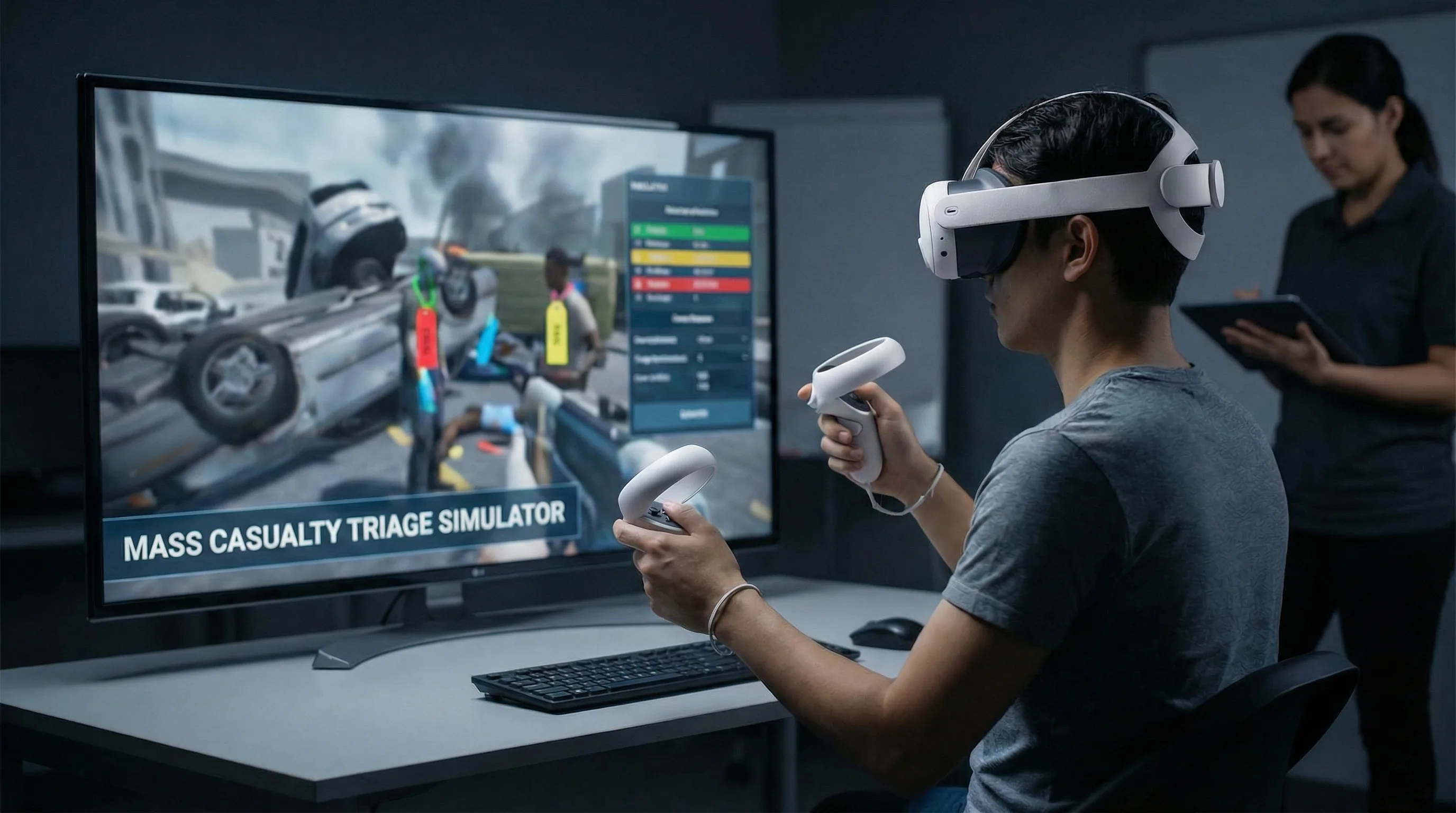
Mass Casualty Triage Simulator
2,000+ paramedics. Two live drills a year at $80K each. Not enough reps to maintain triage competency when every second counts.
Full VR triage simulator with a scenario editor for instructors. Configurable environments, patient profiles, vital signs, and equipment loadouts. Exam and practice modes, single or multiplayer, deployed nationwide on PC and VR headsets.
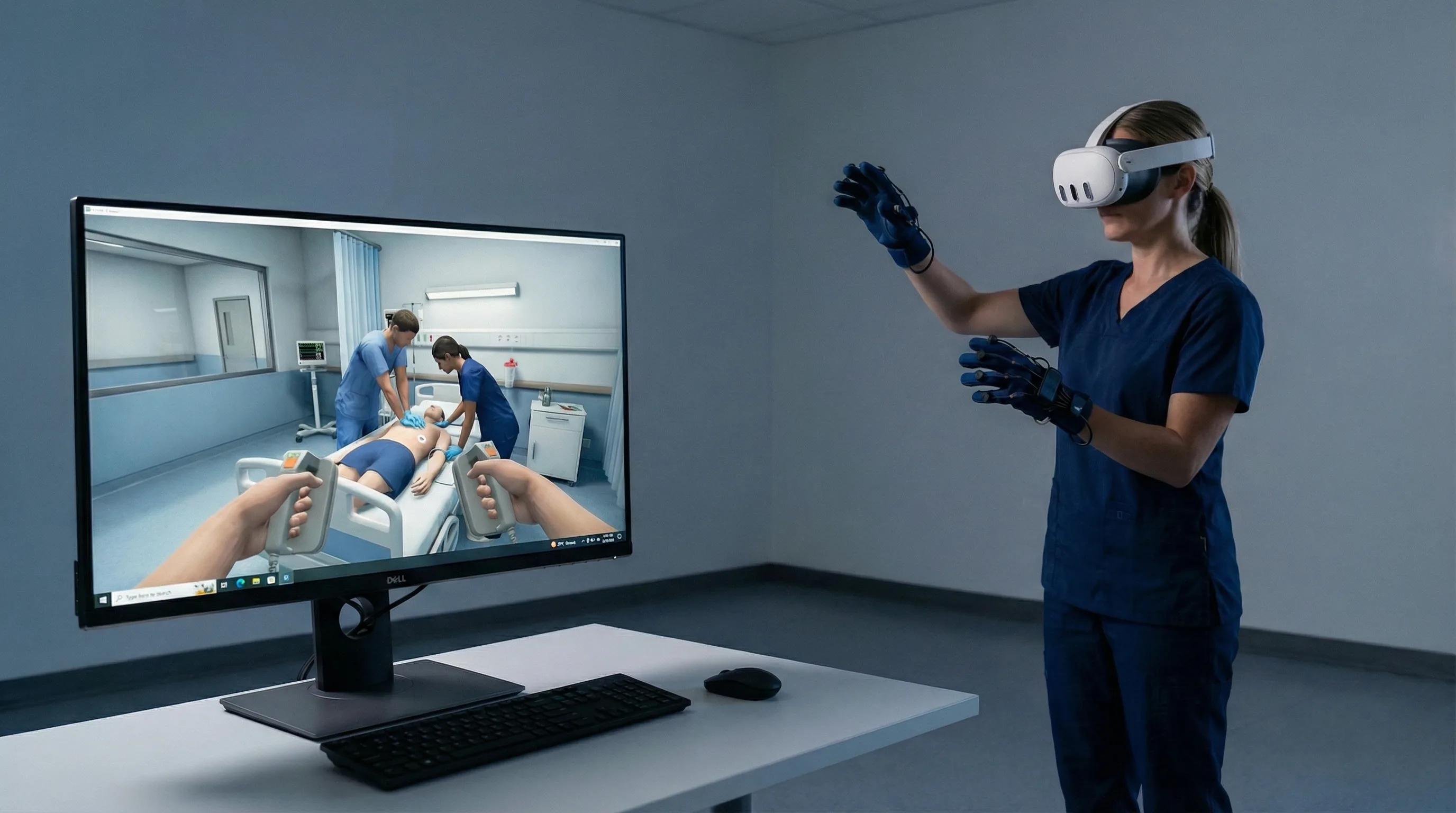
ALS/BLS Resuscitation Training
Overbooked mannequin labs. 3 instructors for 12 students. BLS skills decay within 3–6 months without refreshers — yet scheduling live practice is nearly impossible.
VR simulator for advanced and basic life support with a built-in scenario editor. Students practice solo with unlimited reps, instant feedback, zero scheduling conflicts. An RCT (n=88) confirmed 28% shorter no-flow time and 74% learning gain vs. 27% for the control group.
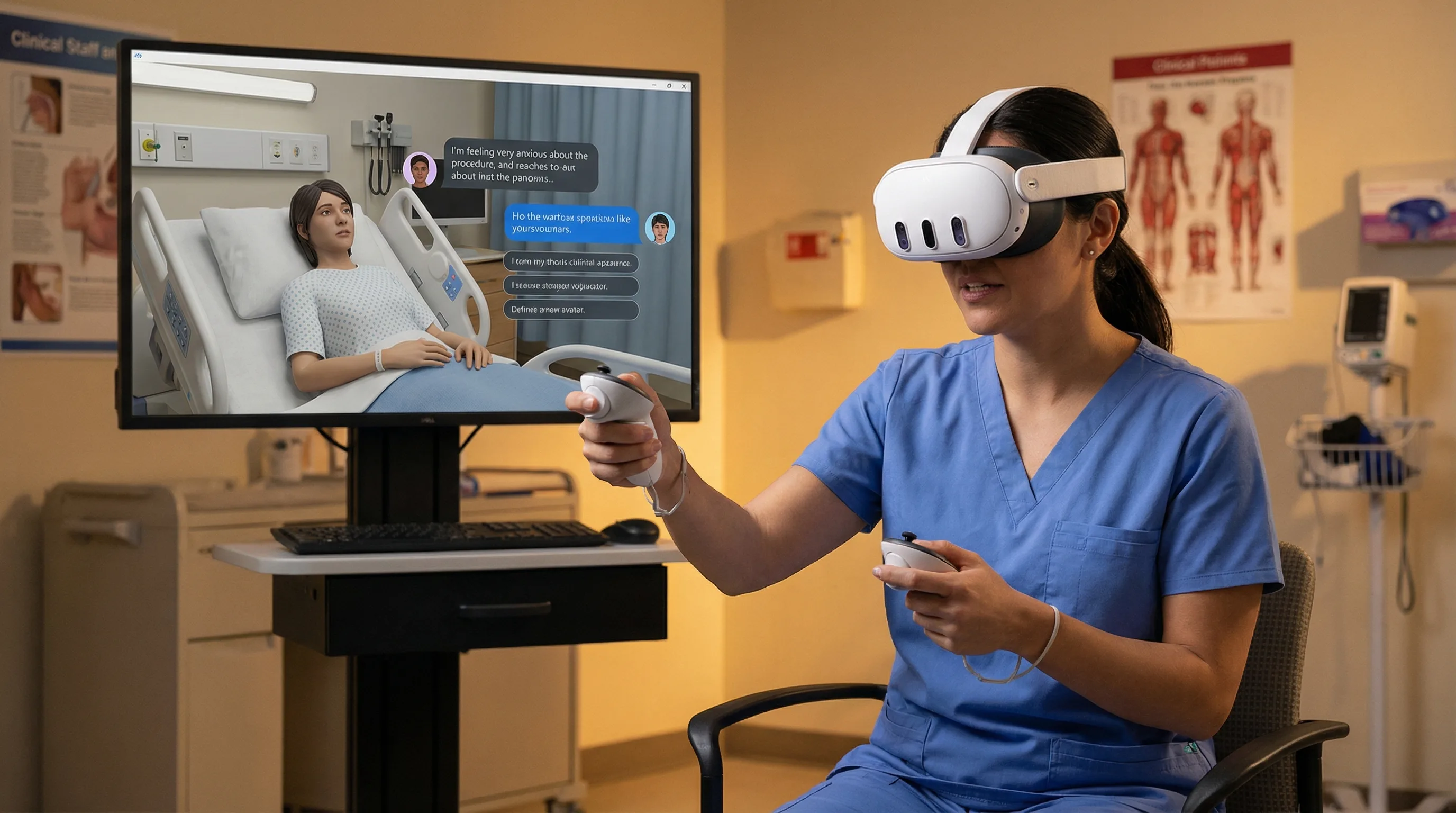
Clinical Empathy & Active Listening
Patient complaints cost hospitals $50K–$100K per claim. Yet empathy training is still roleplay with colleagues — no real emotional pressure, no measurement.
VR scenarios placing clinicians in both patient and provider perspectives. Breaking bad news, de-escalating agitated patients, practicing active listening — all scored by AI. Hospitals using this module saw 34% fewer patient complaints within 6 months.
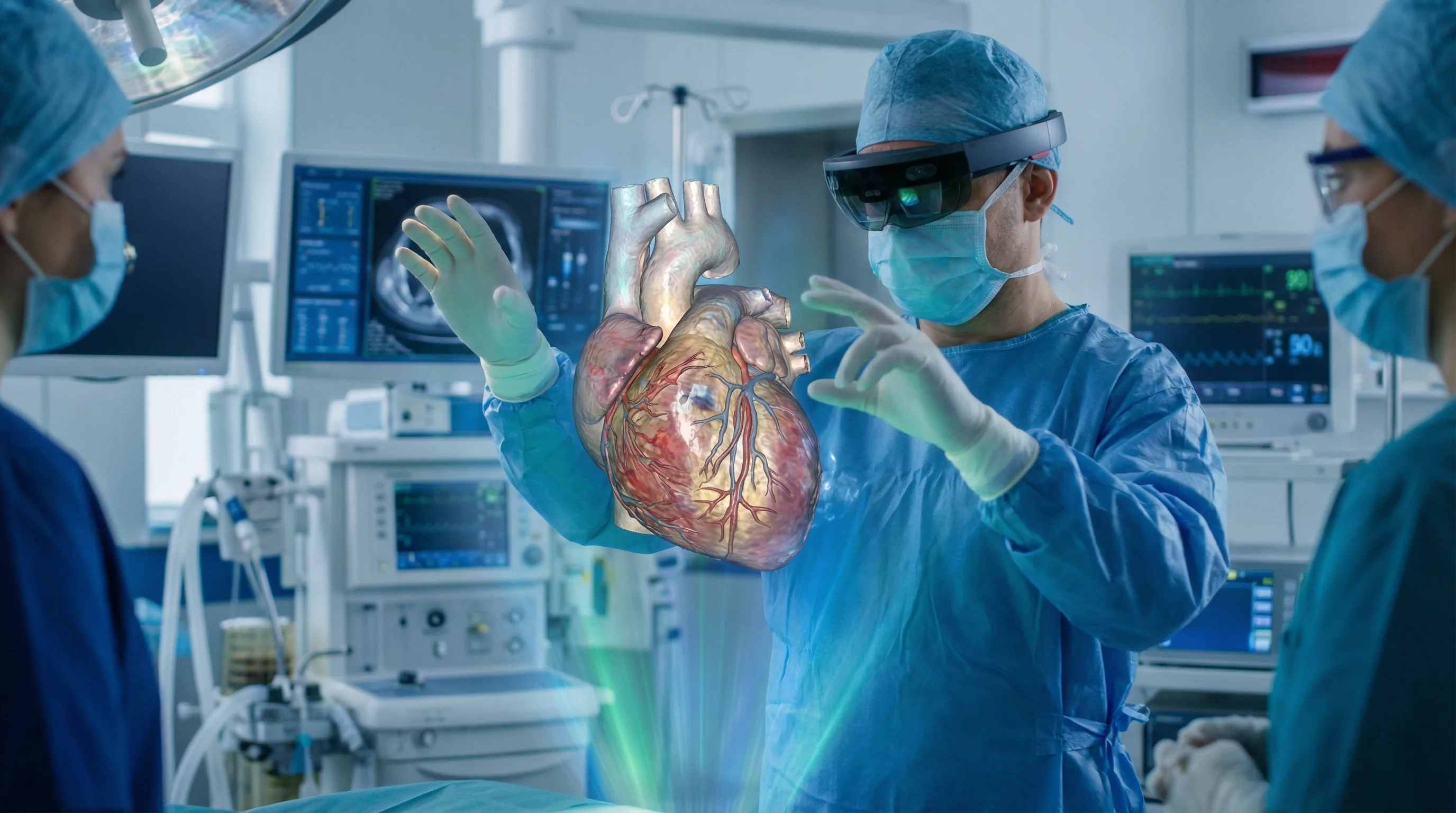
VR Surgical Planning Platform
Surgeons plan from 2D slices on flat screens. Spatial relationships are lost — leading to longer operations, more complications, and costly revisions.
Import patient CT/MRI data into a shared VR environment. The surgical team walks through the anatomy in true 3D, rehearses approach paths, and spots complications before the first incision. Result: 29% faster operations and 6× fewer errors.
FAQ
Healthcare VR Training — FAQ
Our platform
Not every training needs
a custom build.
Our platform lets your team create, deploy, and update XR training in-house. 90% cost savings vs traditional VR development. No developers required.
AI-Powered Personalization
Every learner gets a different path. AI adjusts difficulty, pacing, and content based on real-time performance. Not guessing. Adapting.
No VR Headset Required
Phone, tablet, laptop — training runs on whatever your team has. VR headsets amplify, but are never required.
No-Code Content Editor
Your subject matter experts become content creators. If they can build a presentation, they can build XR training. No developers. No tickets. No $25K change orders.
Comprehensive Analytics
Track competence, not completion. Know exactly who is ready, who needs more time, and where the gaps are.
Industries We Serve
Explore Other Industries
Safety & Industrial
Equipment ops, hazard ID, certified modules
Corporate Skills
Communication, negotiation, leadership
Education & Design
Career prep, architecture, design tools
Emergency Response
Fire response simulation software
Get Started
Your patients can't wait for better training.
Tell us what your clinical team struggles with. First consultation free — we respond within 48 hours.
Prefer email? hello@edutailor.ai